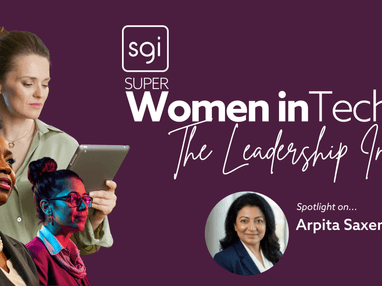
Arpita Saxena
Ex - Director Software Engineering, Ex - NetApp
Curiosity. Ownership. Culture.
These are the three threads that run consistently through Arpita’s career in technology. From being the only girl in her school's computer studies class to leading global engineering teams across continents, her journey has been defined not just by technical depth but also by the ability to turn complexity into clarity and to build teams that deliver at scale.
Across telecom, financial services, GenAI, AI/ML, e-commerce, and multi-cloud partnerships, Arpita has grown from hands-on engineer to Engineering Director for Software Engineering, driving billion-dollar programmes, scaling enterprise customer bases, and leading landmark cloud partnerships without missing a single launch milestone.
In this interview, she reflects on how it all began, the pivotal moments that shaped her leadership style, and why culture remains her most powerful lever in her toolkit.
Q: Let’s start at the beginning. How did your career in technology begin?
It began unexpectedly in sixth grade, when my school introduced a new subject called Computer Studies. My parents did not know what it was — and neither did I — but I was deeply curious. When my dad asked if I wanted to opt in, even though it meant extra fees, I said yes.
That curiosity never left me.
By 11th grade, I was the only girl in a class of 23 studying mathematics and computer studies. Later, at IIT, I was one of six women in a cohort of 417 engineering students. It was noticeable, the imbalance was obvious, but I never saw it as a limitation. Instead it became an opportunity to raise the bar for myself and set a standard for what women in tech could do.
Q: What did you specialise in early in your career?
My foundation was deeply technical. I studied computer science, learned multiple programming languages — from COBOL and Fortran in school to C, C++, and later Java, Python - and quickly developed a strong interest in software architecture.
During my undergraduate years (from the Indian Institute of Technology (BHU), Varanasi, Computer Science and Engineering), I worked on a research paper in image processing and personalisation — concepts similar to what we now see in image/ photo products. I then completed a Master’s in Computer Science at the University of Texas at Dallas, specialising in Software Engineering.
From early on, I gravitated towards solving complex, large-scale problems where architecture, performance and user experience intersect, and that focus has continued to shape my career.
Q: When did leadership become part of your journey?
Leadership evolved naturally for me through impact rather than title.
In 2008, I was given ownership of a heavily used product with a customer satisfaction score of 2.54 out of 5. Instead of just fixing reported defects, I redesigned the user experience, re-architected the product, added automation and gave customers far more self-service control.
Within a year of the new product release, the satisfaction score increased to 5 out of 5.That outcome expanded my scope: I was entrusted with additional products and began stepping into technical leadership roles.
My Manager then encouraged me to build project management skills alongside my technical/ engineering depth. I initially resisted because I did not want to step away from hands-on engineering, but I later realised that understanding execution frameworks allowed me to scale my influence far beyond an individual contributor role.
Q: You’ve worked across multiple industries. How did that breadth shape your leadership?
Each industry strengthened a different muscle.
- Telecom taught me how to think in terms of distributed systems and to design for massive scale.
- Financial services sharpened my focus on regulatory rigour and non-negotiable compliance.
- Payments deepened my understanding of risk management and customer trust.
- GenAI, AI/ML, and strategic pre-sales developed my experimentation mindset and comfort with ambiguity.
- E-commerce demanded resilience and reliability at extreme peak loads.
By the time I moved into senior leadership roles, I was no longer looking at architecture, data residency, compliance, business strategy and customer experience as separate threads, but as an integrated system.
That cross-industry exposure means I now diagnose problems faster, connect dots across domains more naturally, and lead teams with greater confidence through complex, multi-dimensional challenges.
Q: How did you transition into AI and machine learning?
At EY GDS, I was approached to support a project analysing trading data using Python and machine learning models — work that neither my team nor I had done before.
I volunteered to lead and deliver a couple of these projects, treating them as an opportunity to build a new capability for the team, not just a one-off experiment.
I was transparent with my team that this would require us to learn new languages, AI, ML algorithms, and core concepts like supervised and unsupervised learning. Four of us, including me, stepped forward. Instead of waiting for formal training, we created our own learning journey through whiteboarding, deep technical discussions, hands-on experimentation, and constant troubleshooting together.
It became one of the most energising phases of my career because I was not leading from a distance; I was learning in the trenches with my team. That experience not only accelerated my transition into AI and MLK, it also but strong trust, confidence, and momentum that was carried into subsequent data and AI initiatives.
Q: What defines your leadership style today?
Transparency and shared ownership.
I align teams around a clear North Star by answering three questions together:
-
Where are we today?
-
Where do we need to go?
-
How do we get there — together?
Rather than dictating solutions, I focus on creating clarity, enabling collaboration, and making sure everyone understands the “why” behind decisions. That allowed senior technical and managers to take true ownership while staying aligned on outcomes.
Culture is equally important. In one organisation, engagement scores were low when I joined. I went through employee feedback line by line, including anonymous comments, and translated this into concrete changes, such as:
-
Creating visibility hubs that linked day-to-day work to strategy and customer outcomes
-
Introduced peer recognition to celebrate impact, not just delivery
-
Launching cross-regional hackathons to encourage innovation and inclusion
-
Shifting to asynchronous communication during the pandemic to reduce meeting fatigue and support global teams
-
Formalising engineering escalation processes to reduce burnout and ambiguity
Over time, morale and engagement improved significantly, and teams started proactively offering support across boundaries. One moment that stayed with me was hearing my team use the phrase “How can I help?” in meetings where I wasn’t present. That is when you know the culture has taken root and your leadership style is truly embedded, not just communicated.
Q: Tell us about leading the NetApp and Google Cloud partnership.
That was a defining leadership moment.
When NetApp began discussions about our historic first-party partnership with Google Cloud, I was selected to lead the engineering effort. Operating under strict confidentiality, I defined the scope, identified reusable assets, estimated headcount, and orchestrated cross-regional teams while managing timelines, documentation, and executive briefings.
We delivered 10 flawless launches in less than 3 years - zero misses, 140 cloud migrations in about nine months.
Trust stemmed from my weekly translations of technical progress into business outcomes, presenting balanced options (pros/cons) that empowered VP to GM decisions over mere risk alerts. This built C-suite alignment and evolved my style toward transparent, impact-driven leadership.
Q: How do you approach executive communication?
Executives prioritise clarity over technical depth. My approach:
-
Define the problem succinctly
-
Quantify business impact (e.g. “58% downtime reduction unlocked $X revenue)
-
Present 2-3 solution options with pros/ cons
-
Highlight key trade-offs
-
Recommend the optimal path with next steps.
At NetApp, this bridged engineering complexity to C-suite strategy, securing buy-in for GenAI initiatives that drove 45% productivity gains.
Q: What has driven your progression from engineer to director?
Curiosity, ownership and collective delivery.
I have thrived by diving into unfamiliar domains — AI/ ML, GenAI, data engineering, cloud platforms, SRE, DevSecOps, Quality, or organisational transformation - while anchoring in technical architecture, product development, and end-to-end product ownership.
I reject “us versus them” thinking: if one team is blocked, we all are. This mindset, infused with deep technical expertise and business acumen, scaled me from hands-on coding to leading global, multi-vertical teams.
Q: Looking back, what are you most proud of?
Looking back, I am proudest not of scaling from 33 to 200+ enterprise customers or revenue growth, but of cultivating teams that thrive together.
These teams:
-
Support each one other through challenges
-
Embrace continuous learning and innovation
-
Operate with radical transparency transparently
-
Deliver results with unwavering confidence
Tech evolves rapidly, but culture endures. For me, that foundation began at age 11, saying ‘yes’ to my first coding adventure - much like empowering women in tech to seize bold opportunities today.